Stoichiometric Lithium Tantalate (SLT)
Applications:
- Quasi-phase-matched (QPM) nonlinear optical devices
- Visible and ultraviolet wavelength conversion
- High-power frequency conversion systems
- Applications requiring enhanced photorefractive damage resistance
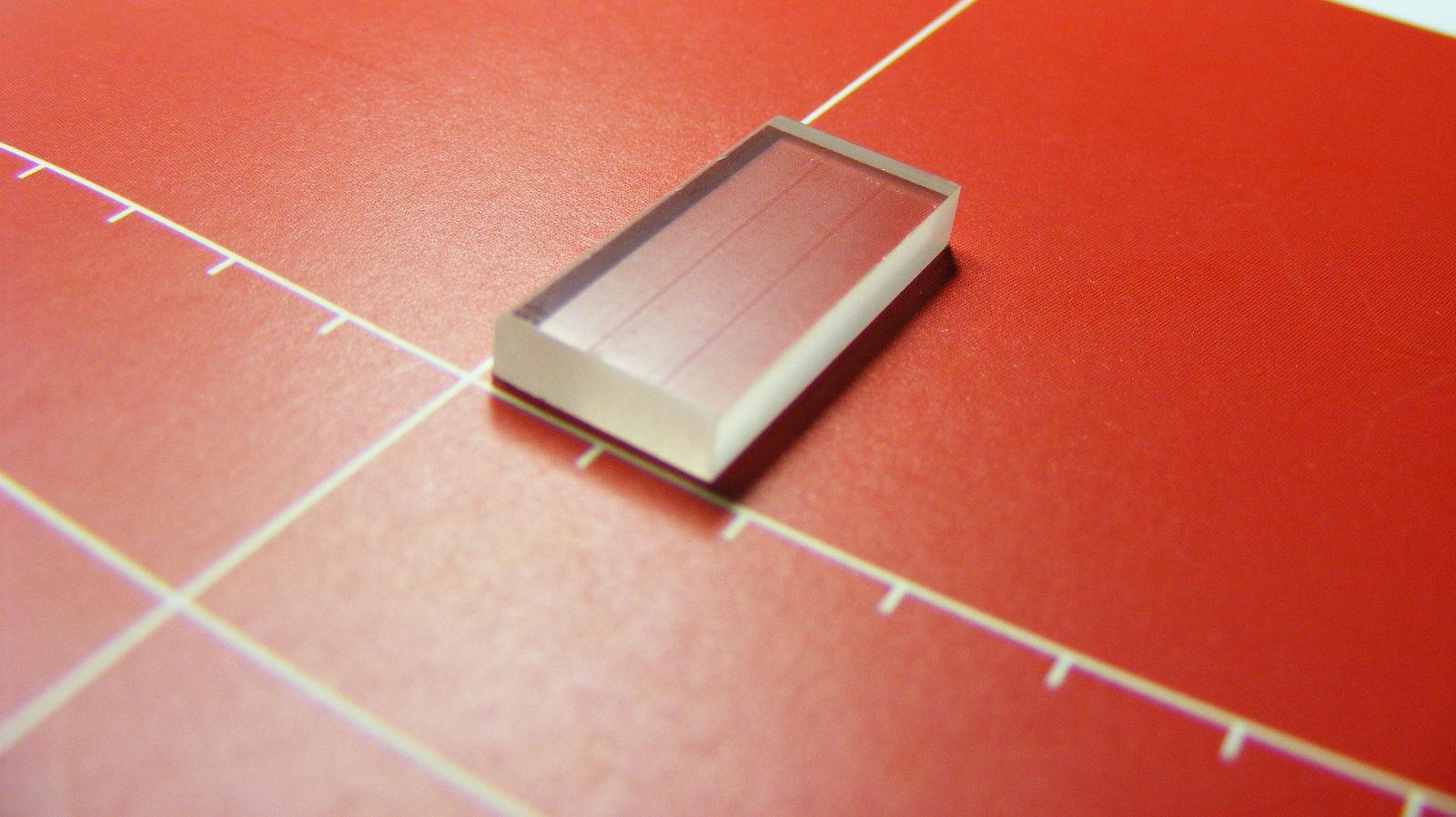
Stoichiometric Lithium Tantalate (SLT) is a high-performance nonlinear optical crystal engineered for applications requiring improved optical damage resistance, enhanced ultraviolet transmission, and stable electro-optic performance. Compared to congruently grown lithium tantalate (CLT), SLT is produced with a lithium-to-tantalum ratio much closer to the ideal 50:50 stoichiometry. This optimized composition significantly reduces intrinsic defect density within the crystal lattice.
The improved stoichiometry results in higher resistance to photorefractive damage, increased nonlinear and electro-optic coefficients, and improved optical transparency, particularly in the visible and UV spectral regions. These characteristics make SLT well suited for demanding quasi-phase-matched (QPM) and high-power optical applications.
At Deltronic Crystal, SLT crystals are grown and processed to support both research-driven development and production-scale device integration.
Built for R&D. Proven for Production.
Technical Overview
Stoichiometric Lithium Tantalate is a ferroelectric oxide crystal whose near-ideal lithium-to-tantalum ratio minimizes antisite defects and charge traps commonly found in congruent materials. The resulting lower defect density leads to improved optical damage thresholds, reduced photorefractive effects, and enhanced UV transmission.
SLT exhibits strong second-order nonlinear (χ²) and electro-optic properties, making it suitable for frequency conversion, modulation, and QPM-based devices. During periodic poling, SLT requires significantly lower coercive fields than CLT, enabling stable domain inversion at reduced voltages. This lower poling voltage allows the fabrication of thicker crystal chips with improved mechanical robustness and thermal stability.
These material advantages support consistent performance in high-power and UV-visible applications where long-term stability, low operating temperature, and resistance to optical degradation are critical.
Key Features and Benefits
- Low coercive field for efficient periodic poling
- Higher optical damage threshold compared to CLT
- Improved UV and visible light transparency
- Enhanced power stability and reduced thermal sensitivity
- Available in undoped and MgO-doped variants
Stoichiometric LiTaO3 (Li/Ta ~ 49.96:50.04)
Transparent Wavelength Range (nm)
Refractive Indices (at 633 nm)
Linear EO Constants (pm/V)
Nonlinear Optical Constants(pm/V)
E-field for Domain Switch (Coercive Field) (kV/mm)
Optical Damage Threshold (kW/cm2 )
Why Choose SLT
Stoichiometric Lithium Tantalate offers a combination of durability, efficiency, and optical performance that exceeds conventional lithium tantalate materials. Its reduced defect structure, improved poling behavior, and enhanced resistance to optical damage make SLT a preferred material for advanced nonlinear and electro-optic devices operating under demanding conditions.
Contact us to discuss specifications, custom requirements, or production volumes.