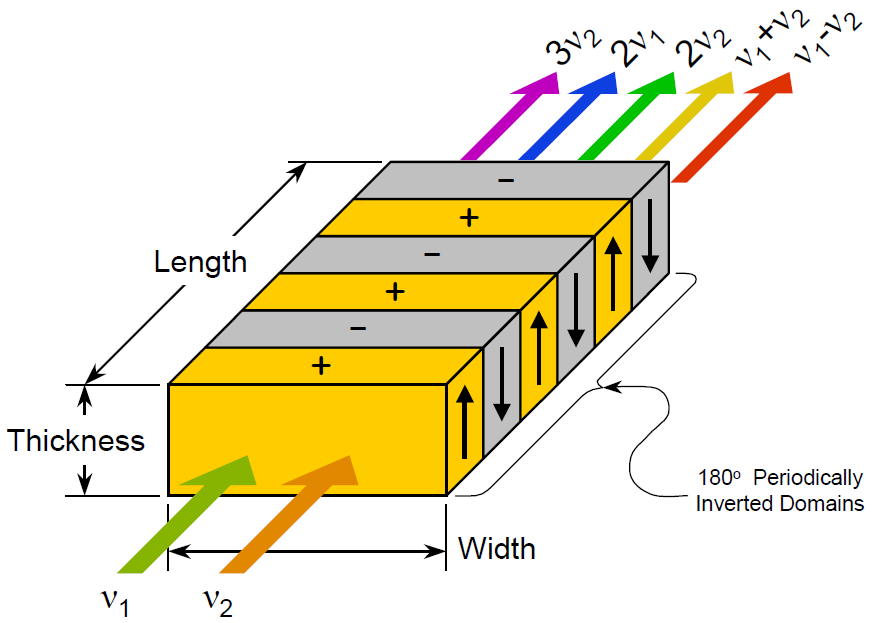
Periodically Poled Stoichiometric Lithium Tantalate (PPSLT)
Applications:
- RGB laser generation
- Infrared (IR) and mid-infrared (Mid-IR) laser generation
- Visible wavelength generation
- First-order and higher-order wavelength conversion
- Remote sensing and detection systems
Efficient Wavelength Conversion for Visible and Infrared Laser Systems
Periodically Poled Stoichiometric Lithium Tantalate (PPSLT) is a specially engineered crystal used to convert laser light into new colors and wavelengths. It is a cost-effective way to generate visible, infrared (IR), and mid-infrared (Mid-IR) light without the need for multiple specialized crystals.
Through a precise manufacturing process, the internal structure of the crystal is permanently modified so it can efficiently change one wavelength of light into another. This allows designers to use a single crystal to handle multiple wavelength-conversion needs, simplifying system design and reducing overall cost.
Because PPSLT works efficiently even with lower-power laser sources, it is well suited for compact, portable, and energy-efficient optical systems used in sensing, imaging, and laser-based applications.
Built for R&D. Proven for Production.
Technical Overview
Periodically Poled Stoichiometric Lithium Tantalate (PPSLT) is a quasi-phase-matched nonlinear optical material designed for efficient wavelength conversion in the visible, IR, and mid-IR spectral regions. PPSLT chips are fabricated using a multi-step lithographic patterning process followed by precision electric-field poling, resulting in permanent ferroelectric domain inversion within the lithium tantalate crystal.
This periodic domain structure enables quasi-phase matching (QPM), allowing efficient nonlinear interactions without reliance on birefringent phase matching or angular tuning. By selecting appropriate grating periods, crystal widths, and interaction lengths, PPSLT supports both first-order and higher-order nonlinear processes, including sum-frequency generation (SFG) and difference-frequency generation (DFG).
PPSLT offers high conversion efficiency when driven by low peak-power laser sources and provides significant design flexibility through single- and multi-grating configurations. These properties make PPSLT an effective alternative to dedicated frequency conversion crystals, particularly in compact and tunable laser systems.
Key Features and Benefits
- Supports sum-frequency and difference-frequency generation
- Broad-range, precise wavelength conversion
- High conversion efficiency from low peak-power laser sources
- Enables compact, lightweight designs for portable systems
- Available with single or multiple grating configurations
- Flexible crystal dimensions and grating period selection
Specifications
Chip Thickness (standard)
5mm and 10mm (custom up to 40mm)
10, 20, 30, 40, 50mm (custom up to 60mm)
Many periods available in the range 4 to 100+ µm
(plus custom periods)
Many multiple grating designs available
To customer specifications
Type I and Type II Phase Matching
To customer specifications
Optically polished to target specifications
Material Property - LiTaO3 (Lithium Tantalate)
d31 = 0.85pm/V
d33 = -13.8pm/V
Surface Damage Threshold for 10ns (J/cm2)
* The above figures are based on wavelength at 1064nm and software “SNLO”
Why Choose PPSLT?
PPSLT combines efficiency, flexibility, and cost effectiveness in a single nonlinear optical platform. It allows system designers to achieve reliable wavelength conversion across multiple spectral regions while simplifying optical layouts and supporting compact system architectures.
Contact us to discuss specifications, custom requirements, or production volumes.